Kambaba Jasper Meaning: A Grounding Guide to the Green Crystal for Calm
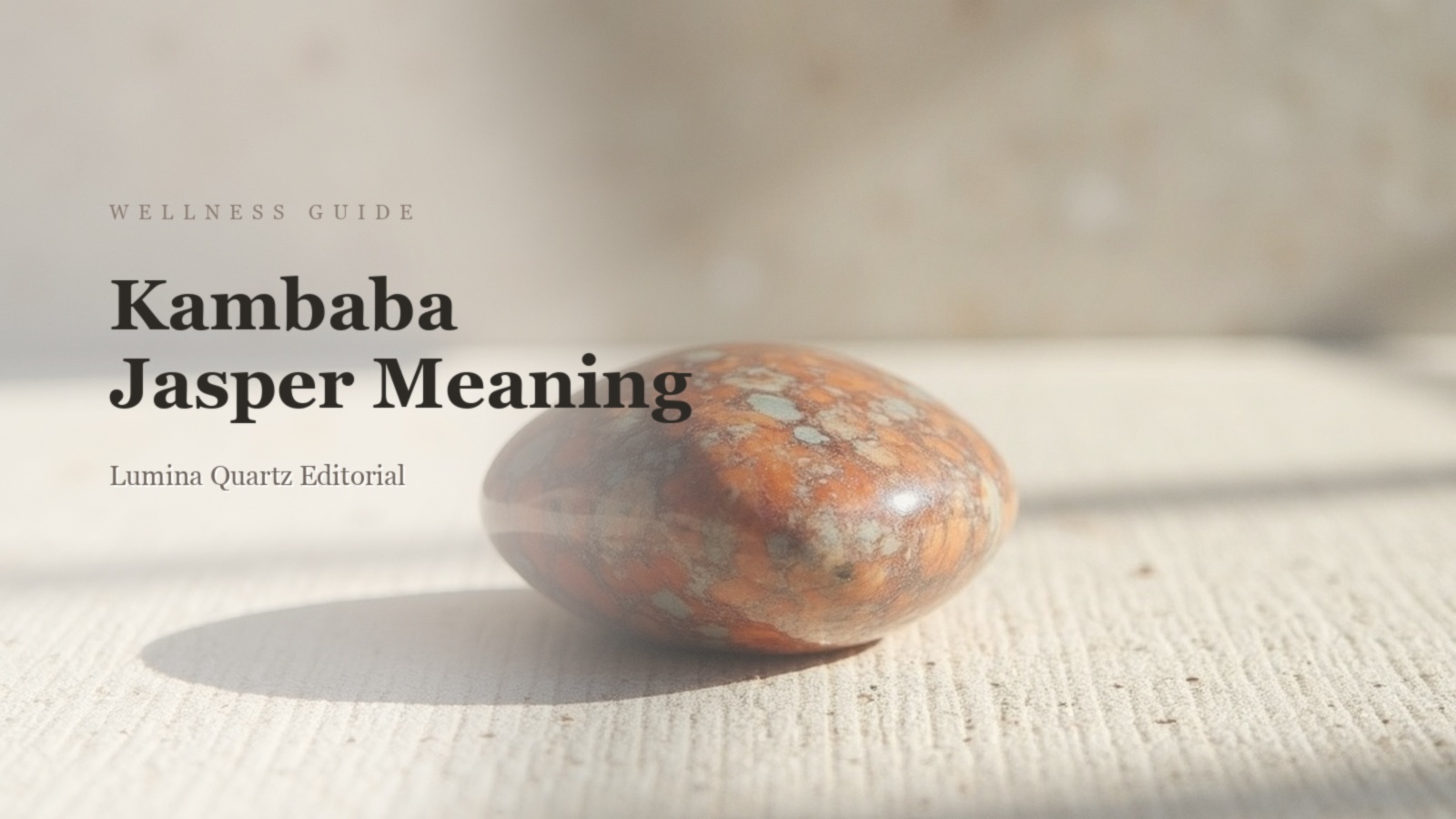
Table of Contents
- What is Kambaba Jasper?
- Kambaba Jasper Meaning and Symbolism
- Kambaba Jasper Metaphysical Properties
- The Science and Controversy: Is Kambaba Jasper a Fossil?
- Healing Properties of Kambaba Jasper
- Kambaba Jasper and the Root Chakra
- How to Use and Care for Kambaba Jasper
- Kambaba Jasper at Lumina Quartz
- Key Takeaways
- Frequently Asked Questions
There are stones that whisper, and stones that hold. Kambaba jasper—with its deep green swirls and dark, dreaming circles—belongs to the latter. It arrives from the ancient soils of Madagascar, carrying the memory of primordial seabeds and the quiet patience of time itself. For those drawn to its gaze, kambaba jasper meaning reaches far beyond the aesthetic. It is an anchor, a steadying presence, and a reminder that growth often begins in stillness.
In a world that asks us to move quickly, this stone asks us to slow down. In a culture that prizes the polished and the perfect, it reminds us that beauty often lives in the raw, the layered, and the ancient. Kambaba jasper does not demand attention; it simply offers presence. And in that presence, many find a sense of profound grounding.
In this guide, we explore the story, symbolism, and practical uses of this remarkable stone, so that you may welcome it into your life with clarity, intention, and an open heart.
What is Kambaba Jasper?
Kambaba jasper is a variety of jasper—a microcrystalline form of quartz—that is most commonly found in Madagascar, with some deposits also located in South Africa and India. Its appearance is unlike many other jaspers: rich shades of forest green and deep teal are punctuated by orbicular patterns of dark charcoal, black, or deep brown. These concentric circles and swirling formations give the stone an almost organic, botanical feel, like a fossilised jungle viewed from above or the surface of a still, ancient pond.
In the lapidary world, kambaba jasper is sometimes referred to as "kambamba jasper" or "crocodile jasper," because of its scaly, textured appearance. It is frequently cut into cabochons, beads, and palm stones, and it is a favourite among those who work with crystal energy for its grounded, soothing resonance. Whether set in silver jewellery or held as a smooth worry stone, its visual depth invites contemplation.
Geologically speaking, kambaba jasper is thought to be a type of sedimentary stone that contains fossilised stromatolites—ancient colonies of cyanobacteria that thrived billions of years ago. While its classification as true jasper is debated, it remains a beloved member of the jasper family in metaphysical and collector communities alike. What is not debated is its ability to capture the imagination and to connect us, in a very tangible way, to the deep history of life on Earth. Mineral collectors have long distinguished this dark green orbicular material from the lighter, tan-orbed "Kambamby" jasper of the same region, a naming distinction that goes back decades in mineralogical literature.
Kambaba Jasper Meaning and Symbolism
The meaning of kambaba jasper is layered, much like the stone itself. At its core, kambaba jasper is often associated with grounding, emotional calm, and the wisdom of ancient Earth. Its green tones echo the lush vitality of life, while the dark orbs remind us of the quiet depths beneath every surface—both in the earth and in ourselves. It is a stone that holds both the light and the shadow, inviting us to hold both within ourselves as well.
Symbolically, kambaba jasper is viewed as a stone of resurrection and renewal. Because it is formed from some of the earliest known forms of life, it carries the energy of endurance and transformation. It speaks to the idea that even the oldest, smallest forms of existence evolve into something beautiful and lasting. For many, kambaba jasper meaning reflects the journey of becoming: we are all shaped by our history, yet we are not defined by it. We are all, in our own way, ancient beings learning to grow anew.
In meditation and daily life, kambaba jasper is often used as a companion for those who feel scattered, overwhelmed, or disconnected from their physical body. It invites a return to the present moment, where healing can take root. It is a stone of patience, teaching us that not everything needs to be resolved at once. Some things, like this stone, simply need time to settle and become.
Kambaba Jasper Metaphysical Properties
When people ask about kambaba jasper metaphysical properties, they are usually describing a cluster of qualities that practitioners associate with the stone. In crystal healing traditions, it is most often grouped as a grounding and protective stone rather than an energising one. Its energy is slow, dense, and steady—closer to the feeling of standing barefoot on cool earth than to the lift of a high-vibration stone.
The most commonly cited metaphysical properties include:
- Grounding and stability: Kambaba jasper is used to help settle scattered energy and bring attention back to the body and the present moment.
- Emotional calm: It is often held during anxious or restless periods as a gentle, reassuring presence rather than a stimulant.
- Protective boundary: Many practitioners place it near doorways or carry it in a pocket as a quiet shield against feeling drained by busy environments.
- Ancestral and Earth connection: Because of its great age and fossil-like appearance, it is associated with connecting to deep time, roots, and lineage.
- Patience and endurance: It is used as a reminder that growth and healing unfold over long horizons, not overnight.
It is worth saying plainly that these are traditional and intuitive associations, not clinical claims. Crystal healing is a personal, complementary practice, and kambaba jasper works best as a companion to—not a replacement for—ordinary rest, routine, and professional care. What the stone offers is a touchstone: something physical to return to when the mind drifts, and a symbol of the stillness you are choosing to cultivate.
Kambaba Jasper vs. Similar Green Stones: A Quick Comparison
Not all dark green stones are kambaba jasper. This table helps you tell it apart and choose the right companion for your intention.
- Kambaba Jasper: Dark forest green base with black or deep brown orbs and swirls. Soft, matte-to-satin finish. Energy: slow, grounding, protective. Best for stillness and emotional calm.
- Red Jasper: Brick-red to terracotta, fairly uniform. Energy: warming, motivating, vitality-focused. Best for energy and forward momentum.
- Black Tourmaline: Black, often striated or columnar. Energy: strongly protective, boundary-setting. Best for clearing heavy environments.
- Kyanite: Blue to blue-green, bladed crystal structure. Energy: aligning, communicative, calming for the mind. Best for reflection and expression.
- Fluorite: Purple, green, or banded and translucent. Energy: clarifying, organising. Best for focus and mental order.
How to Tell Real Kambaba Jasper from a Lookalike
- Look at the orbs: Genuine kambaba jasper has organic, irregular circles and blobs—never perfectly uniform dots.
- Check the colours: The base is dark green to teal-green, with black or very dark brown orbs. Bright, even colour is a warning sign.
- Feel the weight: It should feel solid and slightly cool, not lightweight or plasticky.
- Buy from a source that names the stone: Reputable sellers describe the material and its origin (commonly Madagascar) rather than only using trade nicknames.
Everyday Grounding Checklist
- Keep one palm stone or bracelet on your desk and hold it for a few slow breaths before a demanding task.
- Place a piece by your bed if evenings feel mentally busy—use it as a cue for winding down, not as a sleep treatment.
- Carry it on travel days or crowded commutes when you want a small, familiar anchor in your pocket.
- Pair it with a short walk, a glass of water, or a few minutes of quiet—simple habits the stone can gently remind you to keep.
The Science and Controversy: Is Kambaba Jasper a Fossil?
One of the most frequently asked questions about this stone is whether it is truly a jasper or something else entirely. The answer lies somewhere in the space between mineralogy and folklore, and it is well worth exploring.
Technically, kambaba jasper does not meet the strict definition of jasper, which is an opaque, fine-grained variety of chalcedony. Instead, many geologists classify kambaba jasper as a fossiliferous sedimentary stone, composed largely of silica, with inclusions of what appear to be fossilised stromatolites. Stromatolites are layered biochemical structures formed by ancient cyanobacteria, and they are among the oldest known fossils on Earth, dating back more than three billion years.
This means that when you hold a piece of kambaba jasper, you are quite possibly holding a fragment of primordial life—a tangible link to the dawn of biological history on our planet. That is a profound thought, and one that adds immeasurably to the stone's mystique. It is not merely a decorative object; it is a witness to the perseverance of life itself.
While purists may argue over its classification, the metaphysical community has embraced kambaba jasper as a jasper due to its appearance, texture, and energetic qualities. Whether you call it jasper, stromatolite, or fossilised stone, there is no denying its unique place in the world of crystals and minerals. Sometimes, the most beautiful truths live in the spaces between categories.
Healing Properties of Kambaba Jasper
Kambaba jasper's healing reputation centres on its steadying, reassuring quality. It is not a dramatic stone; it works the way deep roots do—slowly, quietly, and with lasting effect. The sections below describe how that quality is often experienced emotionally, spiritually, and physically within crystal traditions.
Emotional Healing Properties
Emotionally, kambaba jasper is often described as a stone of calm endurance. It is used by people who feel overstimulated, mentally scattered, or caught in repetitive worry. Holding it during a quiet moment can serve as a simple grounding ritual: a cue to slow the breath, soften the shoulders, and return attention to what is actually in front of you. It is frequently chosen as a companion for journaling, therapy-adjacent reflection, or any practice where you want to feel both steady and open.
Spiritual Healing Properties
Spiritually, this stone is associated with connection to the Earth and to ancestry. Its great age and fossil-linked formation make it a natural focal point for meditation on deep time, patience, and the long arc of growth. Some practitioners use it when they want to feel rooted rather than expansive—less about reaching upward and more about settling downward into stability and trust. It can also be a gentle support for grief or transitions, offering a sense of continuity rather than resolution.
Physical Healing Properties
In crystal traditions, kambaba jasper is sometimes held or placed near the lower body with the intention of supporting a sense of physical steadiness and comfort. These are traditional associations, not medical treatments. If you are experiencing pain or a health concern, please speak with a qualified healthcare professional—kambaba jasper is a supportive ritual object at most, never a substitute for proper care.
Kambaba Jasper and the Root Chakra
Kambaba jasper is most commonly associated with the root chakra (Muladhara), the energy centre linked with safety, stability, belonging, and the basic sense of being held by the ground beneath you. In chakra-based practice, the root is the foundation that everything else builds upon, and kambaba jasper's slow, earthy resonance makes it a natural match.
If you work with chakras, you might place a piece of kambaba jasper at the base of the spine or near your feet during meditation, or simply hold it in your hands while setting an intention around feeling safe, settled, and at home in your body. Because its colour is green rather than the traditional red of the root chakra, some practitioners also pair it with the heart chakra—the dark green base echoing growth and the darker orbs echoing depth. There is no single right way to work with it; let your own sense of steadiness guide you.
How to Use and Care for Kambaba Jasper
Kambaba jasper is an easy, forgiving stone to live with. Here are some simple ways to bring it into your routine and keep it feeling like yours:
- Carry it: A smooth palm stone or bracelet in a pocket or bag makes a discreet anchor for busy days.
- Meditate with it: Rest it in your palm or on your lap and use it as a focus point for slow, even breathing.
- Create a small station: Keep a piece beside your bed, your desk, or your journal as a visual cue to pause.
- Cleanse gently: Rinse with lukewarm water and pat dry, or leave it in moonlight or sunlight for a few hours. Avoid harsh chemicals, prolonged soaking, and ultrasonic cleaners, which can stress the stone over time.
- Store thoughtfully: Keep it in a soft pouch or cloth-lined box so its satin surface does not get scratched by harder stones.
There is no required ritual and no wrong way to begin. The value of kambaba jasper lies in the moment of pause it invites each time you notice it—nothing more elaborate than that.
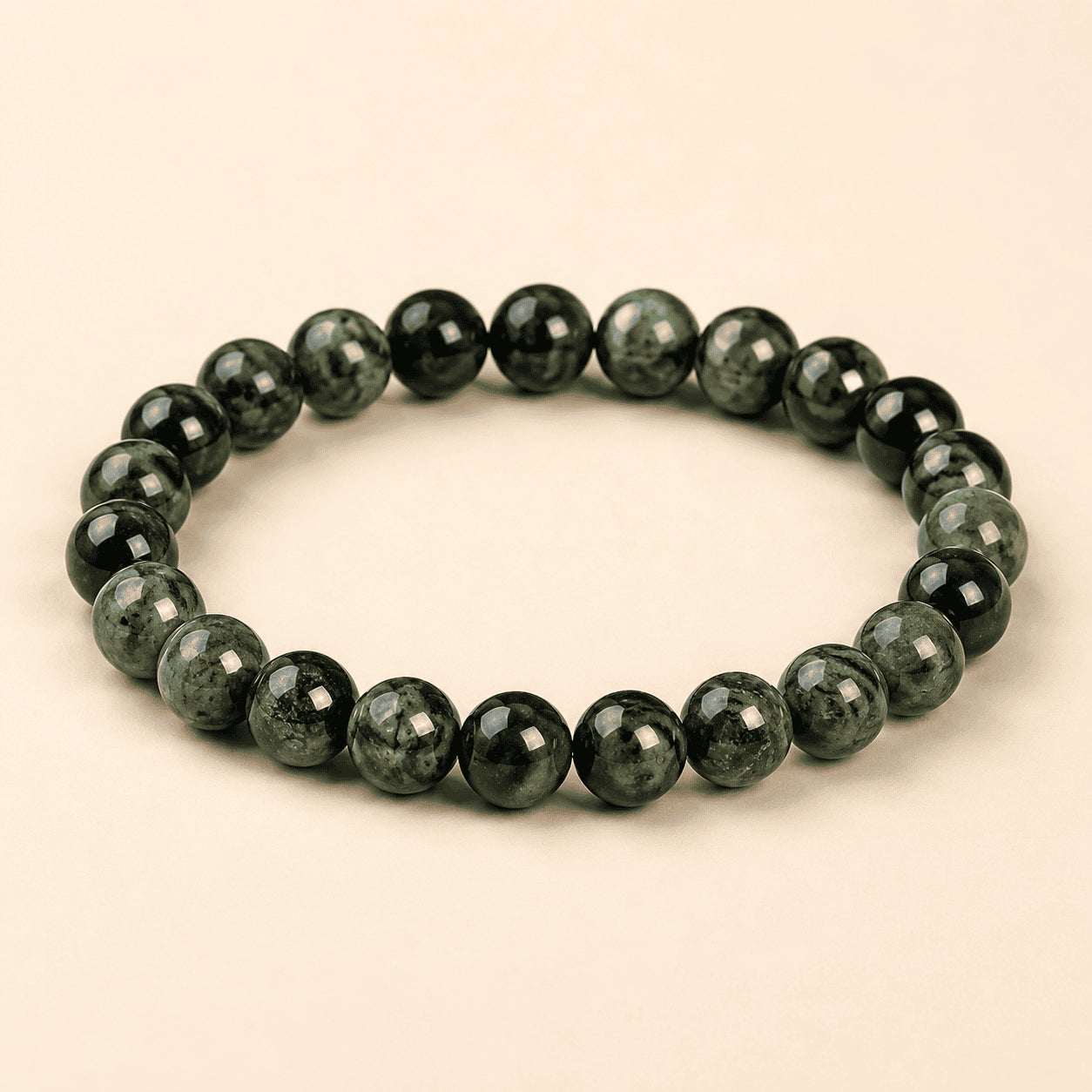
Kambaba Jasper Bracelet
A gentle ritual piece for bringing this intention into your daily routine.
Shop This Authentic Piece →Kambaba Jasper at Lumina Quartz
Every piece in our collection is chosen with the same intention: that the stone you receive feels like a genuine companion. Our Kambaba Jasper Bracelet—Earthy Stillness—is strung from natural, hand-selected beads, each with its own pattern of green and dark orbs, so no two are identical. You can find it in our Kambaba Jasper Bracelet listing, where the stones are photographed as they are, without filters that flatten their depth.
Key Takeaways
- Kambaba jasper is a dark green, orbicular stone primarily found in Madagascar, celebrated for its depth and grounded feel.
- Its meaning centres on grounding, emotional calm, patience, and connection to ancient Earth.
- It is most associated with the root chakra, and sometimes paired with the heart chakra for its green tones.
- Geologically, it is debated as true jasper and is often classified as a fossiliferous sedimentary stone linked to stromatolites.
- It is best used as a supportive ritual object—never as a replacement for rest and professional care.
Frequently Asked Questions
Is Kambaba Jasper actually a jasper or a fossil?
Both descriptions carry some truth. In the strict mineralogical sense, kambaba jasper does not fully meet the definition of jasper, which is an opaque, fine-grained chalcedony. Many geologists instead describe it as a fossiliferous sedimentary stone rich in silica, with inclusions resembling fossilised stromatolites—ancient structures formed by cyanobacteria. In metaphysical and collector communities, it is still lovingly grouped within the jasper family because of its appearance, texture, and steady energetic character. If you find the debate interesting, consider holding both ideas at once: it is a stone that resists a tidy label, and that is part of its charm.
What are the healing properties and benefits of Kambaba Jasper?
Within crystal traditions, kambaba jasper is valued as a grounding and protective stone. People turn to it for a sense of emotional calm, steadiness during busy or overstimulating periods, and support during reflection, meditation, or transitions. It is often described as encouraging patience, helping you feel more present in your body, and reminding you that growth unfolds slowly. These are traditional, intuitive associations rather than medical claims. Think of it as a tactile companion for slowing down—useful alongside rest, routine, and professional care, never instead of them.
Which chakra is Kambaba Jasper associated with?
Kambaba jasper is most commonly linked with the root chakra, the centre associated with safety, stability, and a sense of being grounded. Its slow, earthy resonance makes it a natural fit for root-centred practice: holding it during meditation, placing it near your feet, or using it when you want to feel settled and secure. Some practitioners also pair it with the heart chakra because of its deep green colour, connecting its grounding quality with themes of growth and openness. Either way, the goal is the same—a felt sense of steadiness you can return to.
How do I care for my Kambaba Jasper?
Keep it simple and gentle. Rinse it with lukewarm water when you want to refresh it, pat it dry with a soft cloth, and let it rest in moonlight or sunlight for a few hours. Avoid harsh chemicals, long soaks, and ultrasonic or steam cleaners, which can be hard on the stone. Store it in a soft pouch or cloth-lined box so its satin surface does not get scratched, and it will stay beautiful for years of daily use.
Can I wear Kambaba Jasper every day?
Yes, and many people do. It is a durable stone that holds up well to daily wear as a bracelet or pendant, and its understated combination of green and black makes it easy to pair with most outfits. If you wear it daily, just check the cord or elastic periodically, and give the beads a gentle rinse now and then. Some people like to set a small intention before wearing it—such as staying calm in a meeting or being present with family—so the stone becomes a quiet reminder through the day rather than just an accessory.
Related Reading
- Red Jasper: A Gentle Guide to Meaning, Benefits, and Uses
- Black Tourmaline Meaning: Meaning, Properties, and Everyday Uses
- Kyanite Crystal Meaning: A Guide to Benefits, Uses, and Chakra Alignment
- Fluorite Meaning: Meaning, Properties, and Everyday Uses
- Rose Quartz Crystal: A Gentle Guide to Meaning, Benefits, and Uses
- Sunstone Meaning: Meaning, Properties, and Everyday Uses