Crystal For Anxiety: Best Stones and Simple Daily Rituals
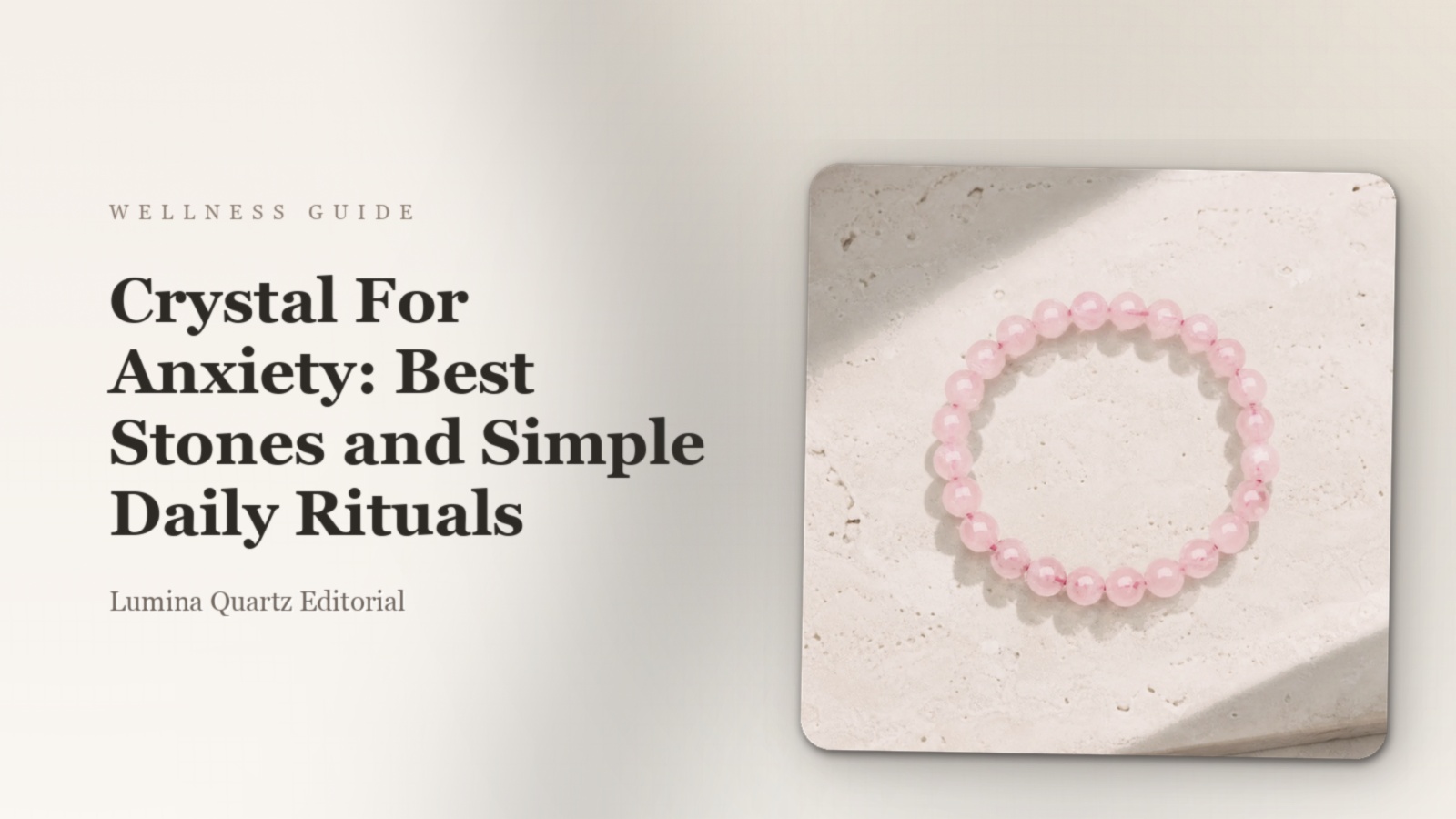
Table of Contents
- What Are Anxiety Crystals?
- Best Crystals for Anxiety and Their Benefits
- How to Choose a Crystal for Anxiety
- What Crystals Can and Cannot Do for Anxiety
- Simple Daily Rituals Using Crystals for Anxiety
- How to Cleanse and Charge Your Crystals
- Key Takeaways
- Frequently Asked Questions About Crystals for Anxiety
- Related Reading
There are moments when the mind hums with a restlessness that words cannot quite catch. You find yourself reaching for something soft, something steady, something older than worry. In this way, crystals have quietly entered the lives of those seeking comfort. They are not magic, and they are not medicine. But they are companions — small, silent anchors in a world that often moves too fast. When we speak of working with a crystal for anxiety, we speak less of miracles and more of ritual: of bringing attention back to the body, the breath, and the present moment.
This gentle guide is offered in that spirit. Whether you are entirely new to crystals or have kept one in your pocket for years, the ideas ahead invite you to slow down, breathe, and listen to what the stones — and your own heart — have to say.
What Are Anxiety Crystals?
Anxiety crystals are precious and semiprecious stones that people often use as tools for emotional grounding and tender self-reflection. The idea is not that the stones themselves carry fear away, but that their presence invites you to pause, to breathe, to feel the weight of something tangible in your hands. Crystals have been used across cultures for centuries as symbols of protection, calm, and inner strength.
It is important to be honest here: crystals are not a replacement for professional medical or mental health care. If anxiety is interfering with your daily life, please speak with a qualified healthcare provider. That said, many people find that working with crystals supports a greater sense of peace, offering a physical reminder to slow down and return to balance. The practice is often paired with mindfulness, intention, and self-compassion — all gentle companions on any wellness journey.
Best Crystals for Anxiety and Their Benefits
Each crystal carries its own quiet personality. Below are five stones often associated with calming energy, grounding, and emotional support. Choose the one that calls to you — your intuition is a guide worth listening to.
Amethyst: The Stone of Serenity
Amethyst, with its crown of violet light, has long been associated with stillness and clarity. Ancient cultures often placed amethyst near their beds to encourage peaceful sleep and vivid dreams. In modern practice it is described as a stone of serenity — one that may support a quiet mind when thoughts begin to race. Its cool purple hue is thought to soothe, and many who work with it say it helps soften the edges of worry. Hold it during moments of overwhelm, or place it on your nightstand to invite rest.
Rose Quartz: The Stone of Love
Rose quartz is the stone of unconditional love — not only for others, but for yourself. When anxiety is rooted in self-criticism, when that inner voice becomes harsh and unforgiving, rose quartz offers a tender counterpoint. Its soft pink blush is often linked with compassion, forgiveness, and the kind of acceptance that comes from the heart. As you hold rose quartz, you may feel a gentle invitation to treat yourself with the same kindness you would offer a dear friend.
Smoky Quartz: The Grounding Stone
Smoky quartz has an earthy, muted beauty — like sunlight caught in fog. It is known as a grounding stone, one that may help you feel anchored and present when the world feels overwhelming. It is often associated with dispersing heavy energy and clearing the mental fog that can accompany anxiety. Some people find that holding smoky quartz during a difficult conversation or a stressful meeting gives them a quiet sense of stability. It is a stone for the soles of your feet and the roots of your being.
Clear Quartz: The Stone of Clarity
Clear quartz is the master stone — a translucent companion often described as an amplifier of intention and a clarifier of the mind. When anxiety muddies your thoughts, clear quartz may support focus and perspective. It is sometimes called the stone of light because of how it reflects and refracts, reminding us that even tangled thoughts can be seen through. It pairs beautifully with any other crystal, offering a quiet boost of purpose.
Black Tourmaline: The Protective Stone
Black tourmaline is the quiet guardian of the crystal world. Its deep, dark color is often associated with protection, grounding, and the gentle deflection of negative energy. For those who feel anxious in crowded spaces, or who are particularly sensitive to the moods of others, black tourmaline may offer a sense of safety and containment. It is a stone of boundaries — a reminder that you are allowed to protect your energy, to say no, to step away. Keep it near your front door, in your pocket, or on your desk.
How to Choose a Crystal for Anxiety
If you are new to this practice, choosing a crystal for anxiety can feel like standing in front of a very large shelf. Here is a simple way to narrow it down:
- Start with the feeling you want. Sleep and quiet evenings point toward amethyst. A harsh inner critic points toward rose quartz. Scattered, foggy thinking points toward clear quartz. Feeling unmoored or overstimulated points toward smoky quartz or black tourmaline.
- Let your hand decide. Hold two or three stones and notice which one you keep returning to. That small pull of attention is usually enough.
- Consider how you will use it. A tumbled stone for your pocket, a bracelet for your wrist, or a palm-sized piece for your nightstand — the format matters as much as the stone.
- Choose one, not five. A single stone you actually carry with you will do more for your practice than a collection that stays in a drawer.
What Crystals Can and Cannot Do for Anxiety
A calm, honest framework makes any ritual stronger. The National Center for Complementary and Integrative Health (NCCIH) at the National Institutes of Health notes that research into complementary approaches for anxiety is still developing, and that evidence for many practices remains limited. That does not make your crystal practice meaningless — it simply places it accurately: as a supportive ritual, not a treatment.
A Practical Boundary Guide
- Crystals may support: a moment of pause, a breathing cue, a physical anchor for intention, a comforting object during stressful moments, and a gentle nudge toward mindfulness.
- Crystals do not replace: therapy, medication, medical evaluation, or the care of a qualified practitioner. They are not a treatment for anxiety disorders, panic, depression, or any diagnosed condition.
- Reach out for professional support if: anxiety persists for weeks, interferes with sleep, work, or relationships, feels unmanageable, or comes with panic symptoms.
- If you are already in care: crystals can sit quietly alongside your treatment plan as a personal ritual. Tell your provider about any complementary practice you use, so your care stays coordinated.
- If you are in crisis: contact a local emergency service or crisis line right away. A stone in your pocket is not a substitute for immediate help.
In other words, the value of a crystal for anxiety is not that it does something to you. It is that it reminds you to do something for yourself.
Simple Daily Rituals Using Crystals for Anxiety
Rituals do not need to be elaborate. A few minutes of consistent, gentle attention is often more supportive than an hour-long ceremony you never repeat.
Morning Meditation with Crystals
Sit somewhere comfortable and rest your stone in your open palm or against your sternum. Close your eyes and take five slow breaths, feeling the weight and temperature of the crystal. Set one small intention for the day — not a goal, just a mood: I will move slowly. I will speak kindly to myself. I will pause before responding. When your mind wanders, return to the sensation of the stone. That return is the practice.
Carrying Crystals Throughout the Day
A tumbled stone in a pocket, a bracelet on your wrist, or a small piece in your bag turns your crystal into a portable reminder. Each time your fingers find it, let that touch be a cue: relax your shoulders, unclench your jaw, take one full breath. You can also choose a specific "anchor" stone for stressful situations — a presentation, a commute, a difficult phone call — and use it only for that, so the association grows over time.
Creating a Crystal Grid for Calm
A crystal grid is simply an arrangement of stones placed with intention. You do not need a formal template. Set a clear quartz point in the center as the anchor, then place amethyst, rose quartz, or smoky quartz around it in a circle. As you set each stone down, name something you are inviting into your space: rest, patience, softness. Leave the grid on a nightstand, desk, or shelf, and let it be a corner of your home that asks you to slow down when you walk past it.
Using Crystals Before Bedtime
Evening is when many people feel anxiety most clearly. Place amethyst or smoky quartz beside your bed, then hold it while you do a short body scan — starting at your feet and moving upward, releasing each area as you exhale. If your mind is busy, keep the stone in your hand as you settle. The goal is not to force sleep; it is to give your body a signal that the day is finished. If you're drawn to amethyst, our Amethyst Calm Bracelet is a simple way to keep that evening intention with you.
How to Cleanse and Charge Your Crystals
Cleansing is a reset — a way of returning your stone to a neutral, receptive state. None of these methods are mandatory, and none are complicated. Choose what fits your materials and your routine.
- Moonlight: Leave your stones on a windowsill overnight during a full or new moon. This is one of the gentlest methods and safe for nearly every crystal.
- Sound: A singing bowl, chime, or even humming over your stone refreshes it without any water or sunlight involved.
- Smoke: Pass the stone through the smoke of dried herbs or incense, holding the intention of clearing as you do.
- Breath and intention: Hold your crystal, breathe slowly, and simply state that it is cleared. This is the most portable method and the one you can use anywhere.
- Water — with caution: Some stones, including selenite, halite, and malachite, should not be soaked. If you are unsure about a stone, use moonlight or sound instead.
To charge a crystal, set it somewhere meaningful — beside a plant, on a windowsill, or on a clear quartz cluster — and hold a clear thought about what you want it to remind you of. Recharge whenever the stone starts to feel like background noise rather than a cue.
Key Takeaways
- Crystals are supportive ritual tools, not medical treatments. They work best alongside, never instead of, professional care.
- Amethyst, rose quartz, smoky quartz, clear quartz, and black tourmaline are five of the most commonly used stones for calm, grounding, self-compassion, clarity, and boundaries.
- Choose one stone, use it consistently, and let the physical touch become your cue to breathe.
- Simple rituals — a morning pause, a pocket stone, a bedside grid, a slow evening wind-down — are more effective than elaborate ones you rarely repeat.
- Cleanse and recharge your crystals whenever the practice starts to feel routine rather than restorative.
Frequently Asked Questions About Crystals for Anxiety
What are the best crystals for anxiety?
The stones most often chosen for calm and grounding are amethyst for serenity and sleep, rose quartz for self-compassion, smoky quartz for grounding, clear quartz for mental clarity, and black tourmaline for protection and boundaries. There is no single "best" stone — the one that feels right in your hand and that you will actually use is the best choice for you.
How do you use crystals for anxiety relief?
Most people use them as a mindfulness anchor rather than as a treatment. Common approaches include holding a stone during slow breathing, carrying one in a pocket as a reminder to relax your shoulders, placing a small arrangement on a nightstand, and using a specific stone only during stressful situations so the association becomes stronger over time. The benefit, if any, tends to come from the pause the crystal prompts rather than from the stone itself.
How do you cleanse and charge anxiety crystals?
Cleansing methods include moonlight, sound, smoke, and simple breath with intention. Charging means setting the stone somewhere meaningful and holding a clear thought about what you want it to remind you of. Water is popular but not universal — softer stones such as selenite and malachite can be damaged by soaking, so moonlight or sound is the safer default.
Can crystals replace therapy or medication for anxiety?
No. Crystals are not a treatment for anxiety, and no stone should take the place of therapy, medication, or medical advice. If anxiety is affecting your sleep, work, relationships, or daily functioning, please speak with a qualified healthcare provider. Crystals can be a comforting personal ritual alongside whatever care you and your provider decide on.
Related Reading
- Crystal Rituals for Beginners: A Simple Guide to Daily Practice
- Daily Crystal Ritual: How to Set Intention, Wear, and Cleanse Your Stone
- Calming Crystals: Crystal Ritual Guide
- Obsidian Bracelet: Your Guide to Grounding & Protection
Sources
However you choose to begin, let it be small and kind. A single stone, a single breath, a single moment of returning to yourself — that is more than enough to start.